January 1, 2026
On January 1, 1892, seventeen-year-old Annie Moore walked down the gangway from the steamship Nevada with her two brothers Anthony, eleven, and Philip, nine, and into history as the first person processed through the newly opened Ellis Island Immigrant Station. Between 1892 and 1954, when Ellis Island closed, more than 12 million immigrants would come through the facility on their journey to the United States.
The establishment of a federal facility for processing immigrants was a long time coming.
Before the Civil War, states processed immigrants to the U.S. on the docks as they came off boats. The system was haphazard and left immigrants bewildered at the bustle and noise of their new country and at the mercy of swindlers who took their money with promises to find them housing and jobs. Cities and states tried to regularize immigration both to protect the newcomers and to make sure they did not end up homeless and starving, a charge on the city.
The 1840s and the 1850s brought an influx to the East Coast of Irish immigrants fleeing the Potato Famine and Germans fleeing economic hardship and the failed 1848 revolutions and of Chinese and Mexicans migrating to California to pan and dig for gold.
In 1855 the state of New York turned the site of a former U.S. Army fort on the southern tip of Manhattan into the Emigrant Landing Depot, more popularly known as Castle Garden. Between its opening on August 3, 1855, and December 21, 1889, the date of the last recorded data for the site, Castle Garden processed 8,280,917, or 75%, of the 10,956,910 immigrants who entered the United States.
When immigrants arrived at Castle Garden, officials divided them into two lines: English speakers and non-English speakers who would need translators. Officials recorded the names of the newcomers, the ship they arrived on, where they were going, and how much money they had. The new arrivals could buy train tickets from licensed agents, contact relatives, and rest, wash, and exchange money without fear of swindlers. An elaborate system for what was essentially a head tax paid by ship masters for each immigrant funded the operations.
But the coming of the Civil War slowed immigration as foreign men wondered if they would end up on the front lines.
In his third annual message on December 8, 1863, President Abraham Lincoln asked Congress to get involved in the process by establishing “a system for the encouragement of immigration.” Like other Republicans, Lincoln believed immigrants contributed mightily to the nation’s economy. He wrote: “there is…a great deficiency of laborers in every field of industry, especially in agriculture and in our mines, as well of iron and coal as of the precious metals,” while “tens of thousands of persons, destitute of remunerative occupation, are thronging our foreign consulates and offering to emigrate to the United States if essential, but very cheap, assistance can be afforded them.”
“[T]he nation is beginning a new life,” he wrote, and “[t]his noble effort demands the aid and ought to receive the attention and support of the Government.”
Republicans agreed. In their 1864 platform they resolved that immigration “should be fostered and encouraged by a liberal and just policy.” Under their leadership, Congress passed the 1864 Contract Labor Law permitting immigrants to borrow money against their future homesteads to finance their voyage to the U.S. and promising that immigrants would not be drafted. Lincoln signed it on July 4, 1864. Immigration picked up again.
But just a decade later, in the midst of the depression that followed the Panic of 1873, California workers angry at what they saw as competition from Asian contract labor prompted federal regulation of Asian immigration to the U.S. In 1875 the Page Act prohibited the migration of contract laborers and alleged sex workers to the U.S. The Page Act did not require the inspection of ships for such people, though, and provided no way to enforce its provisions.
Driving federal immigration regulation more significantly was the 1876 Henderson v. Mayor of New York Supreme Court decision that outlawed all state head taxes on immigrants, thus leaving facilities like Castle Garden and other institutions designed to help poor immigrants without financial support.
Shipping interests and businesses liked the end of the head taxes, but reformers worried that the collapse of immigrant services would make immigrants vulnerable again to swindlers and abusers. They called for federal regulation of immigration. At the same time, agitation against Chinese and Pacific Island immigration in the West continued, and legislators in eastern states worried that the end of the head taxes would stick them with impoverished immigrants in their borders.
Congress didn’t fast-track any such regulation because immigration was falling after the Panic of 1873. But as it began to rise again in 1879, and as Republicans realized they had to court anti-Chinese votes in California after a razor-thin loss there in 1880, lawmakers turned back to the issue.
In 1882, Congress passed the nation’s first sweeping federal regulations of immigration, with not one law, but two. The Chinese Exclusion Act prohibited the immigration of Chinese workers, although not scholars, diplomats, or businessmen. Three months later, the Immigration Act of 1882 imposed a 50-cent head tax on arriving immigrants and prohibited the entry of convicts, mentally ill individuals, and “any person unable to take care of him or herself.”
Nine years later, in 1891, Congress modified the 1882 Immigration Act to expand government control of immigration and to authorize and fund a federal immigration bureau that would both process legal immigrants and enforce immigration restrictions against those deemed unable to enter the U.S. The new law expanded the reasons that individuals could be rejected from the U.S, including physical illness with contagious diseases. The law made it clear that the federal government would have to replace Castle Garden with its own facility.
Officials turned to Ellis Island in upper New York Harbor offshore from Castle Garden, expanding the former site of oyster beds with landfill until eventually it came to cover about 27.5 acres. On the site, the government built a two-story structure as a main receiving building, then added a hospital, utility plant, laundry, offices, and a detention center.
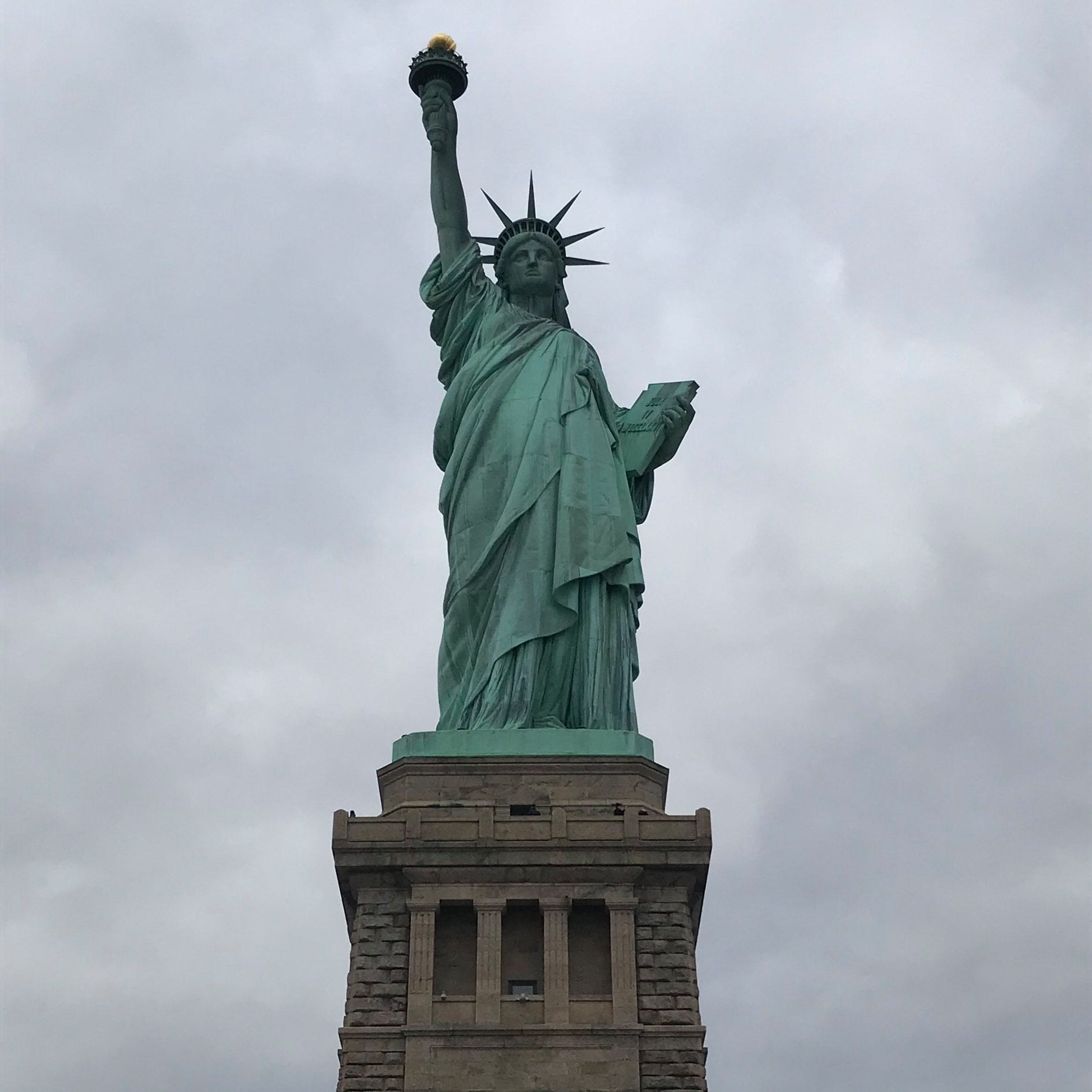
Immigrants arrived at Ellis Island after a two-week journey from Europe. After entering New York Harbor, they sailed by the nearby Statue of Liberty on Liberty Island, dedicated just six years before the facility at Ellis Island opened. A gift to the people of the United States from the people )of France, Lady Liberty stood on a broken chain and shackle that symbolized the abolition of slavery in the U.S., and held up a torch to the newcomers. She held a tablet that represented the law. It was engraved with “July IV MDCCLXXVI”—July 4, 1776, the date of the Declaration of Independence.
When the immigrants’ ship anchored in New York Harbor, healthy first-class and second-class passengers, who had received a brief examination aboard ship, did not have to undergo the inspections the third-class passengers did. Those passengers, along with any people who were sick, boarded a barge or a ferry for the inspection station on Ellis Island. Once they arrived, they could expect to wait three to five hours for what would be an inspection of just a few minutes if they were in good health. Doctors would examine them for obvious illness, and officials would try to make sure they would be able to support themselves. Because steamship companies had to pay for the return trip of anyone who couldn’t pass inspection, as well as a fine for bringing those folks ineligible for immigration, they performed their own inspections in Europe, prescreening the people who arrived at Ellis Island.
On June 15, 1897, the wooden buildings of the original Emigrant Landing Depot burned to the ground, taking with them all immigration records held there since 1855. The government rebuilt, this time making the buildings fireproof. The new facility’s Registry Room, known as the Great Hall, served as many as 5,000 people a day. After arrival, the newcomers sat on benches under the huge arched windows and the spectacular Gustavino tiled ceiling, waiting to be called. After medical inspectors determined their physical fitness, legal inspectors asked the immigrants’ name, home town, occupation, destination, and how much money they had.
Once through their inspection, immigrants proceeded to the “Stairs of Separation.” Those bound for New York or New England moved down the left stairs. Immigrants headed anywhere else went down the stairs on the right. The middle stairs were for immigrants headed for the hospital or to dormitories to wait for a special board of inquiry hearing on their case. Those detained made up about 20% of those arriving, but ultimately only about 2% of them were denied entry.
From Ellis Island the newcomers rejoined family and friends or made their way to other states to work in factories or mines, or on farms. In 1965, Ellis Island became part of the Statue of Liberty National Monument, formalizing its connection to Lady Liberty and the poem inscribed on the base of the statue in 1903. Emma Lazarus turned away from the old Colossus of Rhodes, the giant statue of the Greek sun god Helios that stood at the entrance to the harbor of the island of Rhodes and was one of the Seven Wonders of the Ancient World, to offer the world “The New Colossus,” a woman, Lady Liberty, the “Mother of Exiles.”
“Keep, ancient lands, your storied pomp!” cries she
With silent lips. “Give me your tired, your poor,
Your huddled masses yearning to breathe free,
The wretched refuse of your teeming shore.
Send these, the homeless, tempest-tost to me,
I lift my lamp beside the golden door!”
Notes:
https://www.nyhistory.org/blogs/castle-garden-where-immigrants-first-came-to-america
https://en.wikipedia.org/wiki/Annie_Moore_(immigrant)#/media/File:Annie_Moore_Arrival.jpg
#/media/File:Annie_Moore_Arrival.jpg)
https://commons.wikimedia.org/wiki/File:Annie_Moore_grave_marker.jpg

https://www.nps.gov/cacl/learn/historyculture/castle-garden-emigrant-depot.htm
https://immigrationhistory.org/timeline/
https://www.uscis.gov/about-us/our-history/stories-from-the-archives/refugee-timeline
https://www.presidency.ucsb.edu/documents/third-annual-message-9
https://www.statueofliberty.org/ellis-island/overview-history/
https://www.nps.gov/media/video/view.htm?id=8B7E4516-0E9D-4C91-8C86-78D4E1D8E805
https://www.nps.gov/places/000/registry-room-great-hall-2nd-floor.htm
https://www.lincolncottage.org/lincolns-forgotten-act-to-encourage-immigration/
https://www.presidency.ucsb.edu/documents/republican-party-platform-1864
Edith Abbott, “Federal Immigration Policies, 1864–1924,” The University Journal of Business, 2(March 1924): 133–156.
I am only alive because of Ellis Island. And that goes for millions of others.
This country was FOUNDED on immigration. The Republicans understood this as well as anyone, as recently as Ronald Reagan.
What a sad descent into bigotry bordering on madness…
Ahhh, the history of immigrants coming to America. The one thing we rarely talk about, sadly, is that the immigrants coming here were processed by OTHER IMMIGRANTS!
Only Native Americans are the non-immigrants amongst us.