February 14, 2026
On Valentine’s Day in 1884, Theodore Roosevelt lost both his wife and his mother.
Four years before, Roosevelt could not have imagined the tragedy that would stun him in 1884. February 14, 1880, marked one of the happiest days of his life. He and the woman he had courted for more than a year, Alice Hathaway Lee, had just announced their engagement. Roosevelt was over the moon: “I can scarcely realize that I can hold her in my arms and kiss her and caress her and love her as much as I choose,” he recorded in his diary. What followed were, according to Roosevelt, “three years of happiness greater and more unalloyed than I have ever known fall to the lot of others.”
After they married in fall 1880, the Roosevelts moved into the home of Theodore’s mother, Martha Bulloch Roosevelt, in New York City. There they lived the life of wealthy young socialites, going to fancy parties and the opera and traveling to Europe. When Roosevelt was elected to the New York State Assembly in 1881, they moved to the bustling town of Albany, where the state’s political wire-pullers worked their magic. Roosevelt’s machine politician colleagues derided the rich, Harvard-educated young man as a “dude,” and they tried to ignore his irritating interest in reforming society.
In the summer of 1883, Alice discovered that she was pregnant, and that fall she moved back to New York City to live with her mother-in-law. There she awaited the birth of the child who Theodore was certain would arrive on February 14.
As headstrong as her father, Roosevelt’s daughter beat her father’s prediction by two days. On February 12, Alice gave birth to the couple’s first child, who would be named after her. Roosevelt was at work in Albany and learned the happy news by telegram. But Alice was only “fairly well,” Roosevelt noted. She soon began sliding downhill. She did not recover from the birth; she was suffering from something at the time called “Bright’s Disease,” an unspecified kidney illness.
Roosevelt rushed back to New York City, but by the time he got there at midnight on February 13, Alice was slipping into a coma. Distraught, he held her until he received word that his mother was dangerously ill downstairs. For more than a week, “Mittie” Roosevelt had been sick with typhoid. Roosevelt ran down to her room, where she died shortly after her son reached her bedside. With his mother gone, Roosevelt hurried back to Alice. Only hours later she, too, died.
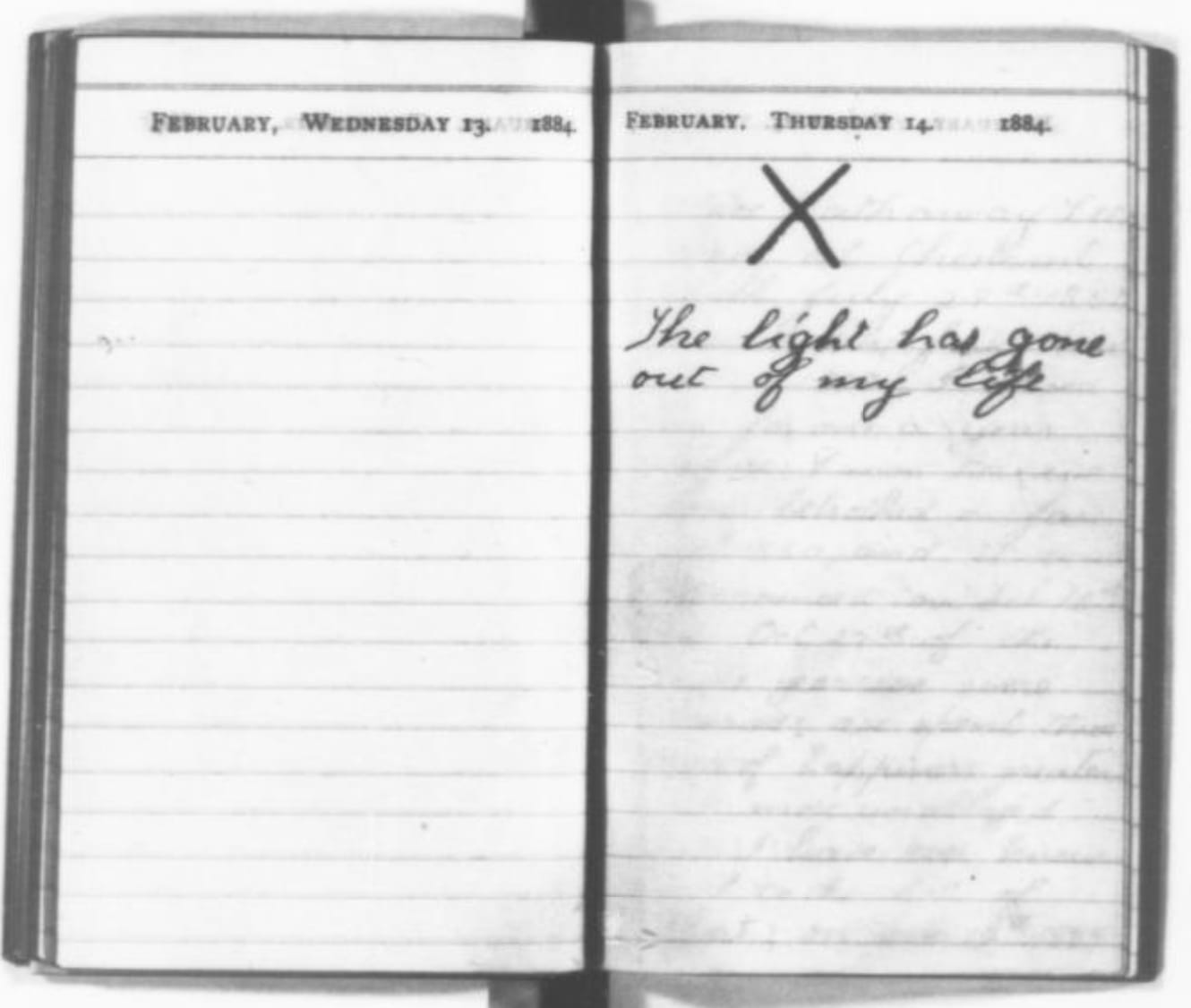
On February 14, 1884, Roosevelt slashed a heavy black X in his diary and wrote “The light has gone out of my life.” He refused ever to mention Alice again.
Roosevelt’s profound personal tragedy turned out to have national significance. The diseases that killed his wife and mother were diseases of filth and crowding—the hallmarks of the growing Gilded Age American cities. Mittie contracted typhoid from either food or water that had been contaminated by sewage, since New York City did not yet treat or manage either sewage or drinking water. Alice’s disease was probably caused by a strep infection, which incubated in the teeming city’s tenements, where immigrants, whose wages barely kept food on the table, crowded together.
Roosevelt had been interested in urban reform because he worried that incessant work and unhealthy living conditions threatened the ability of young workers to become good citizens. Now, though, it was clear that he, and other rich New Yorkers, had a personal stake in cleaning up the cities and making sure employers paid workers a living wage.
The tragedy gave him a new political identity that enabled him to do just that. Ridiculed as a “dude” in his early career, Roosevelt changed his image in the wake of the events of February 1884. Desperate to bury his feelings for Alice along with her, Roosevelt escaped to Dakota Territory, to a ranch in which he had invested the previous year. There he rode horses, roped cattle, and toyed with the idea of spending the rest of his life as a western rancher. The brutal winter of 1886–1887 changed his mind. Months of blizzards and temperatures as low as –41 degrees killed off 80% of the Dakota cattle herds. More than half of Roosevelt’s cattle died.
Roosevelt decided to go back to eastern politics, but this time, no one would be able to make fun of him as a dude. In an era when the independent American cowboy dominated the popular imagination, Roosevelt now had credentials as a westerner. He ran for political office as a western cowboy taking on corruption in the East. And, with that cowboy image, he overtook his eastern rivals.
Eventually, Roosevelt’s successes made establishment politicians so nervous they tried to bury him in what was then seen as the graveyard of the vice presidency. Then, in 1901, an unemployed steelworker assassinated President William McKinley and put Roosevelt—“that damned cowboy,” as one of McKinley’s advisers called him—into the White House.
Once there, he worked to clean up the cities and stop the exploitation of workers, backing the urban reforms that were the hallmark of the Progressive Era.
[Photo of Theodore Roosevelt’s diary, Library of Congress.]
It is so interesting that tragedy both for Theodore and Franklin Delano made them see the blight of the people and steered their offices to have empathy for all, not just a chosen class.
Thanks Heather!
A Valentine’s Story, for All of You by Beverly McNeff
It was Valentine’s Day, and Joey was busy making Valentines for everyone in his class. His mother was happy to see her little boy so joyful and giving, but deep dread had creeped into her heart, because she was worried that the other children would not remember to give a Valentine to Joey. You see, Joey was a little slower than the rest of the kids. He was often forgotten because his mental deficiencies meant that he offered little value to them. But that did not seem to stop him from getting into the spirit of Valentine’s Day. Joey was determined not to forget even one of his peers.
Valentine’s Day arrived, and his mother waited worriedly as the time neared when Joey would be coming home. To lessen his disappointment, if no one had given him a Valentine, she had baked his favorite cookies.
Looking out the window with her cookies in hand and heart in her throat, she saw her beloved little boy turn the corner. He was saying something to himself, but she could not make it out—Her heart jumped another octave. But, as he got closer, she could see that beautiful smile of his, lighting up his face. When he walked into the kitchen, he turned that smile on her as a beam of joy hit her and exclaimed, “I didn’t miss a one, Mom, I didn’t miss a one!”
It was then she realized that he didn’t have any Valentines in his hands. None had been given him, a mix of emotions flooded his mother. Tears welled.
But, his joy was not in receiving a Valentine, it was in giving them away. Joey had made sure that every child was remembered. He didn’t “miss a one.” That was what brought him joy.
What brings you joy?