August 9, 2026
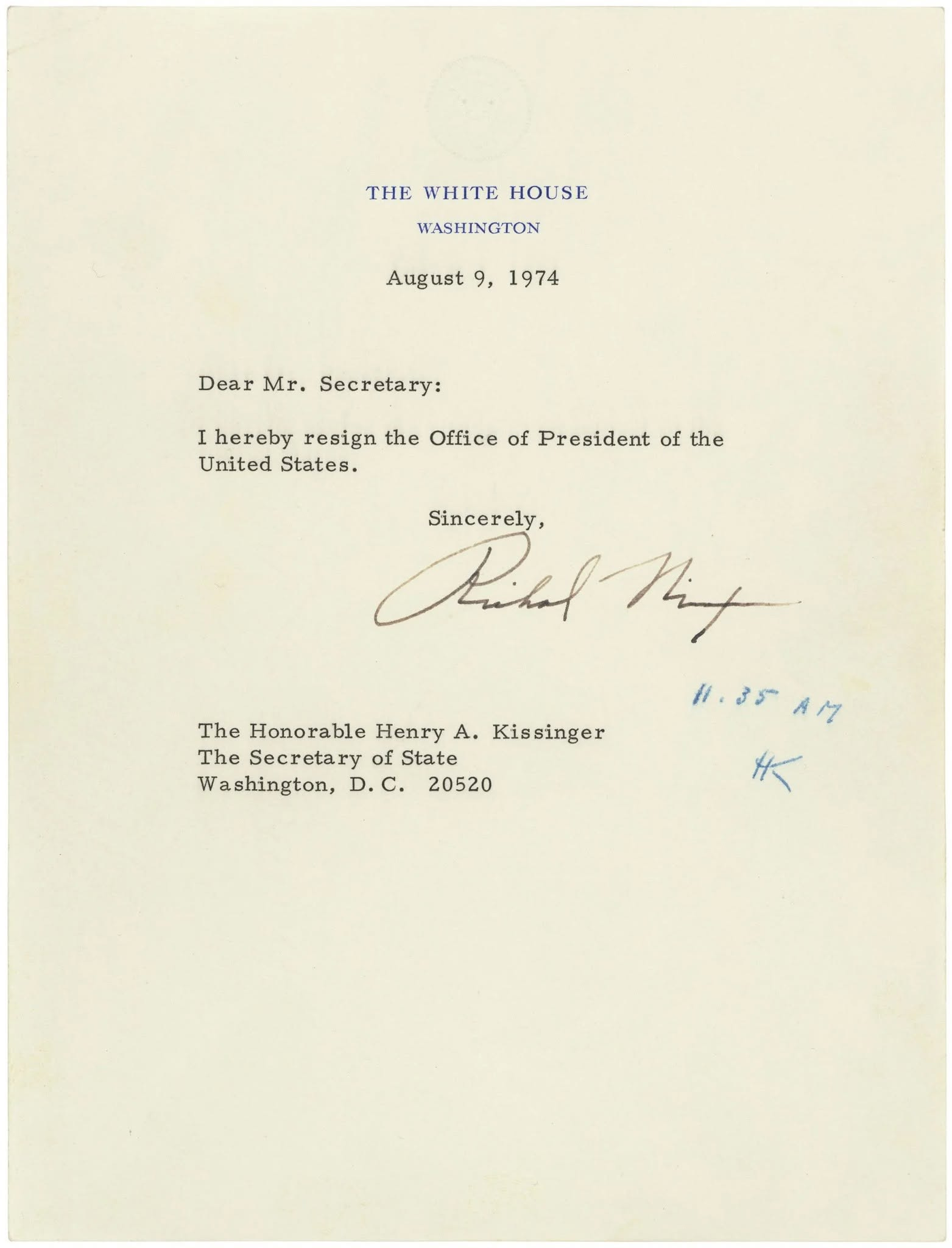
On August 9, 1974, Richard M. Nixon became the first president in U.S. history to resign.
The road to that resignation began in 1971, when Daniel Ellsberg, who was at the time an employee of the RAND Corporation and thus had access to a top-secret Pentagon study of the way U.S. leaders had made decisions about the Vietnam War, leaked that study to major U.S. newspapers, including the New York Times and the Washington Post.
The Pentagon Papers showed that every president from Harry S. Truman to Lyndon B. Johnson had lied to the public about events in Vietnam, and Nixon worried that “enemies” would follow the Pentagon Papers with a leak of information about his own decision-making to destroy his administration and hand the 1972 election to a Democrat.
The FBI seemed to Nixon reluctant to believe he was being stalked by enemies. So the president organized his own Special Investigations Unit out of the White House to stop leaks. And who stops leaks? Plumbers.
The plumbers burglarized the office of Ellsberg’s psychiatrist in California, hoping to find something to discredit him, then moved on to bigger targets. Together with the Committee to Re-elect the President (fittingly dubbed CREEP as its activities became known), they planted fake letters in newspapers declaring support for Nixon and hatred for his opponents, spied on Democrats, and hired vendors for Democratic rallies and then scarpered on the bills. Finally, they set out to wiretap the Washington, D.C., headquarters of the Democratic National Committee, in the fashionable Watergate office complex.
Early in the morning of June 17, 1972, Watergate security guard Frank Wills noticed that a door lock had been taped open. He ripped off the tape and closed the door, but on his next round, he found the door taped open again. Wills called the police, who arrested five men ransacking the DNC’s files.
The White House immediately denounced what it called a “third-rate burglary attempt,” and the Watergate break-in gained no traction before the 1972 election, which Nixon and Vice-President Spiro Agnew won with an astonishing 60.7% of the popular vote.
But Bob Woodward and Carl Bernstein, two young Washington Post reporters, followed the sloppy money trail back to the White House, and by March 1973 the scheme was unraveling. One of the burglars, James W. McCord Jr., wrote a letter to Judge John Sirica before his sentencing claiming he had lied at his trial to protect government officials. Sirica made the letter public, and White House counsel John Dean immediately began cooperating with prosecutors.
In April, three of Nixon’s top advisors resigned, and in May the president was forced to appoint former solicitor general of the United States Archibald Cox as a special prosecutor to investigate the affair. That same month, the Select Committee on Presidential Campaign Activities, informally known as the Senate Watergate Committee, began nationally televised hearings. The committee’s chair was Sam Ervin (D-NC), a conservative Democrat who would not run for reelection in 1974 and thus was expected to be able to do the job without political grandstanding.
The hearings turned up the explosive testimony of John Dean, who said he had talked to Nixon about covering up the burglary more than 30 times, but there the investigation sat during the hot summer of 1973 as the committee churned through witnesses. And then, on July 13, 1973, deputy assistant to the president Alexander Butterfield revealed the bombshell news that conversations and phone calls in the Oval Office had been taped since 1971.
Nixon refused to provide copies of the tapes either to Cox or to the Senate committee. When Cox subpoenaed a number of the tapes, Nixon ordered Attorney General Elliot Richardson to fire him. In the October 20, 1973, “Saturday Night Massacre,” Richardson and his deputy, William Ruckelshaus, refused to execute Nixon’s order and resigned in protest; it was only the third man at the Justice Department—Solicitor General Robert Bork—who was willing to carry out the order firing Cox.
Popular outrage at the resignations and firing forced Nixon to ask Bork—now acting attorney general—to appoint a new special prosecutor, Leon Jaworski, a Democrat who had voted for Nixon, on November 1. On November 17, Nixon assured the American people that “I am not a crook.”
Like Cox before him, Jaworski was determined to hear the Oval Office tapes. He subpoenaed a number of them. Nixon fought the subpoenas on the grounds of executive privilege. On July 24, 1974, in U.S. v. Nixon, the Supreme Court sided unanimously with the prosecutor, saying that executive privilege “must be considered in light of our historic commitment to the rule of law. This is nowhere more profoundly manifest than in our view that ‘the twofold aim (of criminal justice) is that guilt shall not escape or innocence suffer.’... The very integrity of the judicial system and public confidence in the system depend on full disclosure of all the facts….”
Their hand forced, Nixon’s people released transcripts of the tapes. They were damning, not just in content but also in style. Nixon had cultivated an image of himself as a clean family man, but the tapes revealed a mean-spirited, foul-mouthed bully. Aware that the tapes would damage his image, Nixon had his swearing redacted. “[Expletive deleted]” trended.
In late July 1974, the House Committee on the Judiciary passed three articles of impeachment, charging the president with obstruction of justice, abuse of power, and contempt of Congress. Each article ended with the same statement: “In all of this, Richard M. Nixon has acted in a manner contrary to his trust as President and subversive of constitutional government, to the great prejudice of the cause of law and justice and to the manifest injury of the people of the United States. Wherefore Richard M. Nixon, by such conduct, warrants impeachment and trial, and removal from office.”
And then, on August 5, in response to a subpoena, the White House released a tape that proved to be the “smoking gun” Republicans had demanded before they would impeach and convict Nixon. Recorded on June 23, 1972, just six days after the Watergate break-in, the tape was a recording of Nixon and his aide H.R. Haldeman plotting to invoke national security to protect the president. Even if he hadn’t known of the crime itself—although the tape suggested that he had—Nixon clearly had been central to the cover-up. A delegation of Republican lawmakers went to the White House to tell Nixon that he must resign or be impeached by the full House and convicted by the Senate.
In his resignation speech, Nixon refused to acknowledge that he had done anything wrong. Instead, he told the American people he had to step down because he no longer had the support he needed in Congress to advance the national interest. He blamed the press, whose “leaks and accusations and innuendo” had been designed to destroy him. His disappointed supporters embraced the idea that there was a “liberal” conspiracy, spearheaded by the press, to bring down any Republican president.
[Nixon’s resignation letter from the National Archives, public domain.]
Watergate didn’t end because one person or institution saved the country. It ended because, at every stage, people were willing to do their jobs even when doing so carried consequences.
Journalists kept digging. Prosecutors demanded evidence. Justice Department officials refused an improper order. The courts upheld the law. Congress ultimately acted.
Institutions don’t defend democracy by themselves. The rule of law survives only when people choose to uphold it.
Oliver Wendell Holmes, Jr. put it pithily:
"The life of the law has not been logic; it has been experience."
Heather frequently reminds us of three turning points in U.S. history – the 1850s, the 1890s, and the late 1920s and early ‘30s – when human experience festered under the rich. In the 1850s it seemed the southern enslavers were triumphant, that their conceits would thence govern all U.S. life. In the 1890s gilded age plutocrats seemed beyond reproach. In the late 1920s and early 1930s no one could see beyond Wall Street financiers.
But the near total logic of their control gave way to human restiveness whose potency and direction no one could see taking shape in the 1850s, 1890s, and early 1930s.
I happened to see “Miracle on the Hudson” a couple times recently. The computers and flight simulators in it gave unanimous verdicts all based on technology’s best logic.
But Sully, played by Tom Hanks, prevailed. He and the many who rushed to that rescue.
Heather often repeats here that humanity across America may prevail Nov. 3.
We the many again facing down today’s version of enslavers, plutocrats, financiers.